


What you could have saved over this sunny June with Two Blues Solar

Whether you’re a sun worshipper or you can’t stand the heat, if you’re anything like us then I’m sure your mind has turned to solar panels over the last few weeks. You’ve probably wondered how much your business could have saved on energy bills, if only you’d had solar on the roof before this heat wave rolled in.
Well wonder no more – we have taken the time to model five identical commercial sites across the country to give you a taste of what a few sunny weeks with solar panels could have saved you.
Before we get into our findings, here are some of the key factors affecting potential electrical output of solar PV systems, which are always considered at the outset of any solar project:
1. Solar Irradiance:
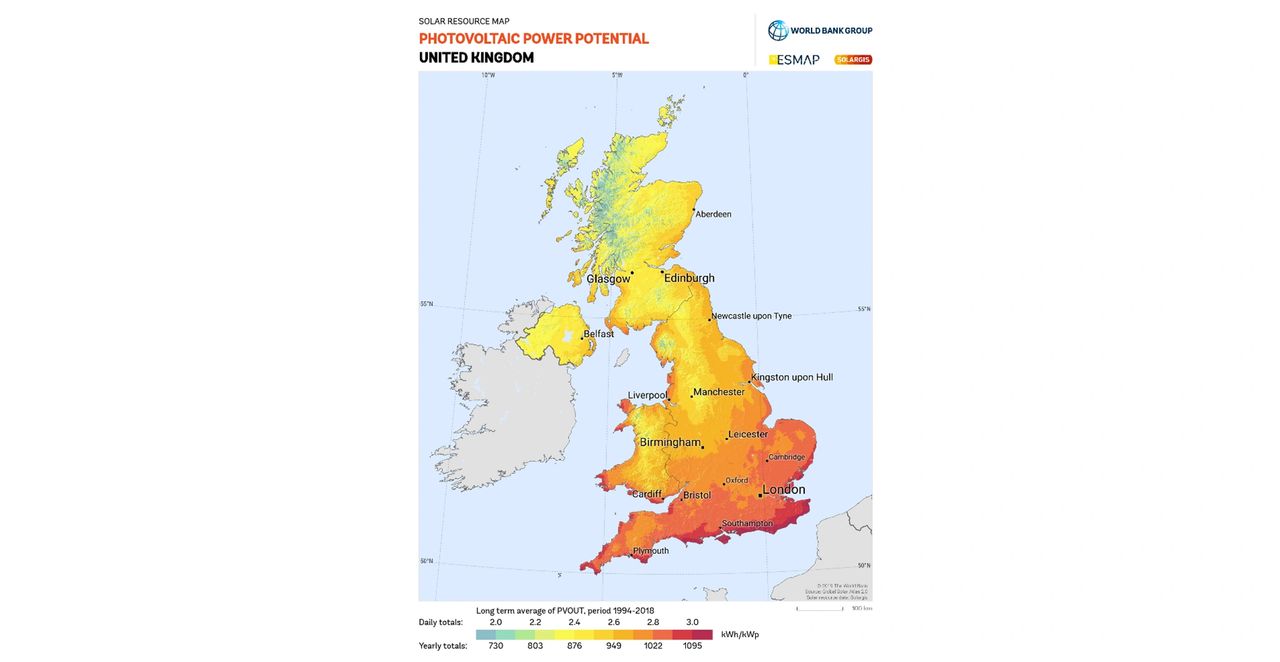
The intensity and duration of sunlight, known as solar irradiance, is the key factor that determines a solar panel’s ability to produce electricity.
The higher the level of solar irradiance, the higher the potential to generate electrical output. This can be significant, and as the irradiance map above shows, your location can greatly affect the output of a solar PV system:
2. Panel Orientation and Tilt:
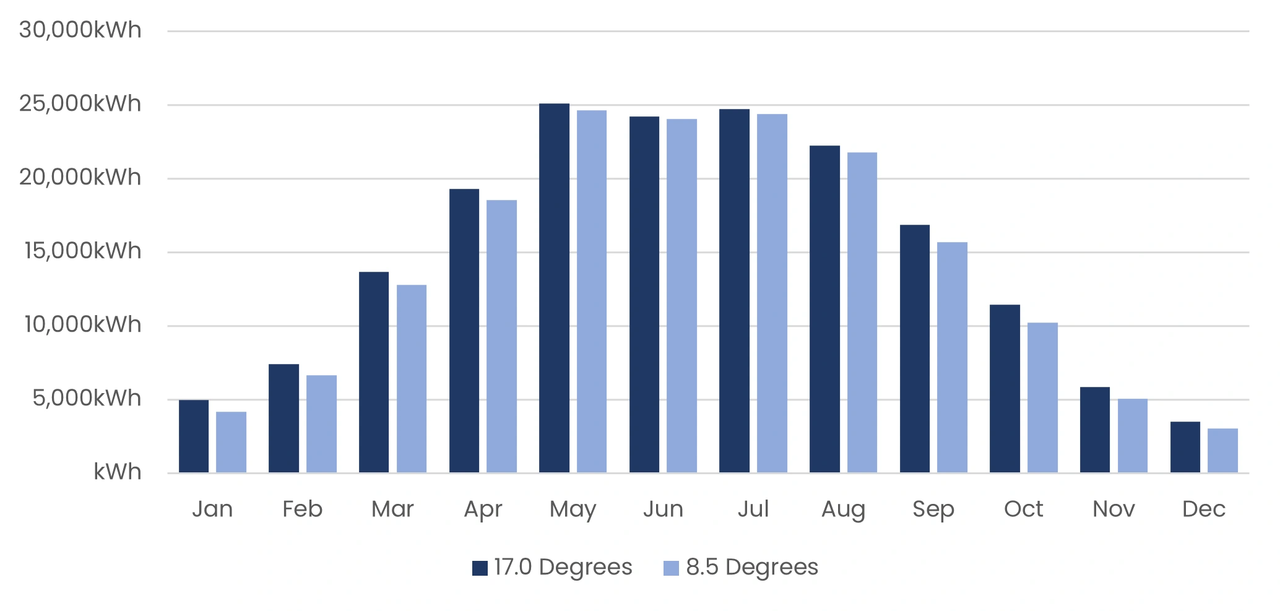
The orientation and tilt angle of solar panels significantly influences their yield. Panels facing south in the Northern Hemisphere (or north in the Southern Hemisphere) receive maximum sunlight throughout the day as it passes from east to west (or vice versa). Optimal tilt angle is affected by the height of the sun, and so there is also a specific angle for each location that provides the largest potential energy production over a whole year. Notice how, above, 17 degree panels perform better than 8 degree panels, particularly during the winter months when the sun is lower in the sky.
3. Shading:
Similarly, shading can be very detrimental to solar panel performance. Because solar panels, like batteries, are typically wired in series, even partial shading of one panel can significantly reduce the output of the whole string, typically 10-15 panels. (i.e. all panels connected in one line which usually constitutes 10-15 panels). Shading can be caused by nearby buildings, trees, or other obstructions so it is important to design solar installations in a way that minimizes shading during peak sunlight hours.
4. Temperature:
Solar panels are sensitive to temperature changes, and excessive heat reduces their efficiency. Whilst the sunniest countries in the world produce the highest levels of solar irradiance, they often also produce the highest temperatures. The maximum optimal temperature for solar production is around 25 degrees centigrade. In hotter climates, cooling mechanisms, such as proper airflow and ventilation, become even more crucial.
5. Panel Quality and Technology:
The quality and type of solar panel technology used also impact electrical production. Different panel materials, such as monocrystalline, polycrystalline, or thin-film, have varying efficiencies and performance characteristics. Higher-quality panels with advanced technologies generally have better yields and may also be more durable, ensuring long-term performance. This is why Two Blues Solar only installs panels from manufacturers listed in Bloomberg’s Tier 1 list.
So how does the location of your site affect solar savings?
Here is our handy guide to how much you could be saving if Two Blues Solar funded and installed a new renewable solar array on your roof, plugged directly into your building.
We modelled five 20,000 sq ft steel framed warehouses with north / south facing 8.5 degree pitched roofs at different locations across the UK. We used the same panels and inverters at all sites, assumed that the whole roof is covered by panels and that all the energy produced is consumed by the building. The locations (Glasgow, Manchester, Birmingham, London and Eastbourne) were chosen based upon the general bands of UK solar irradiance in the SolarGIS diagram.
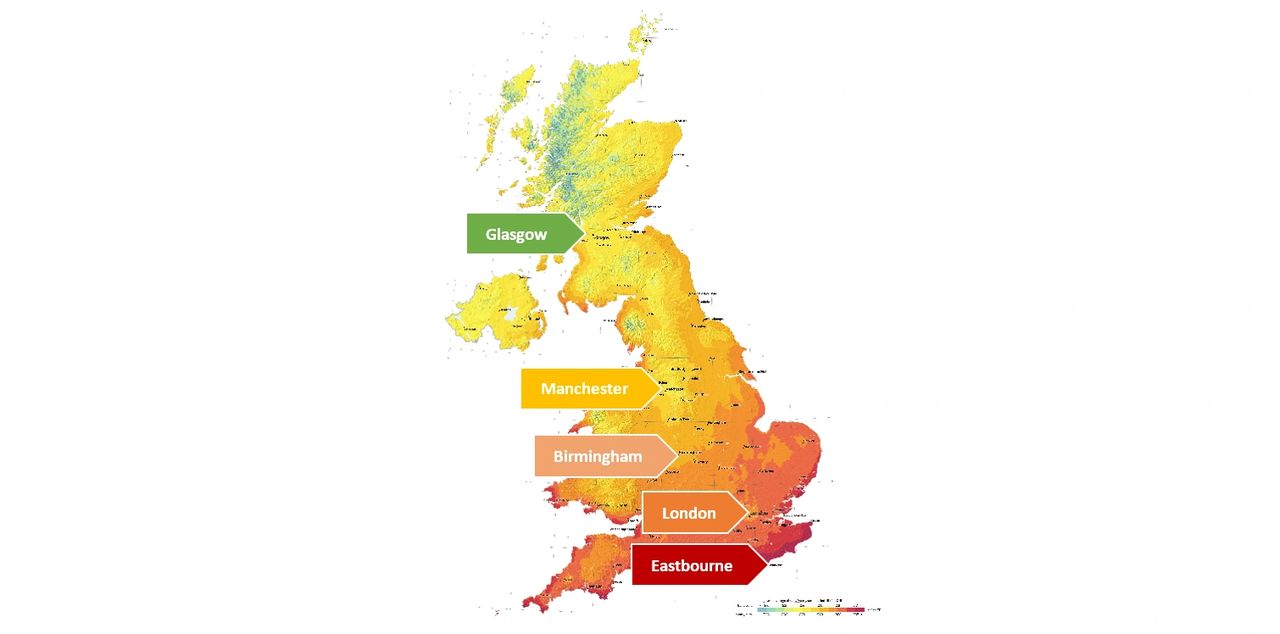
Here’s a look at how the solar production varies in each location across the year:
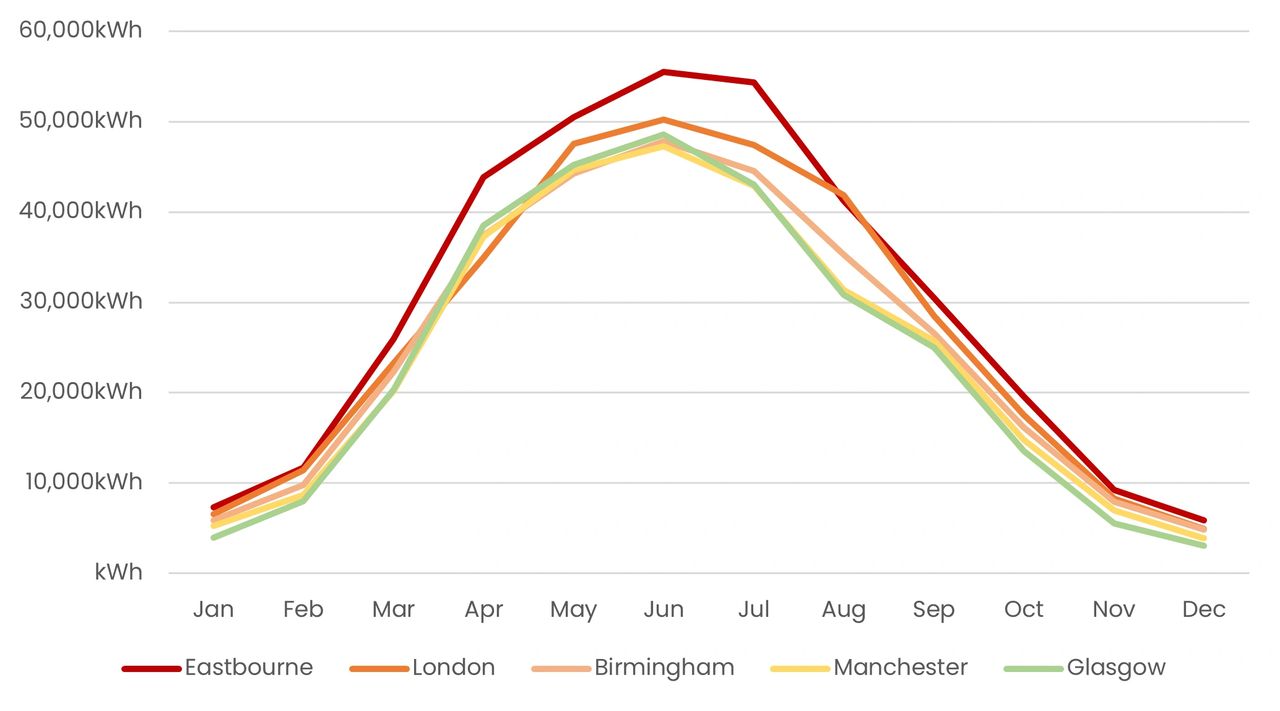
As expected, our modelling found that solar panels would produce more energy across the year in locations where the solar irradiance is higher.
We then took this further and worked out the potential savings that Two Blues can typically offer for these warehouses. We assumed a current energy price of 30 p/ kWh and that with the above sized system we could provide the energy at 13 p/kWh.

The upshot of this is that yes, the benefits of solar PV vary from location to location in the UK, and that, in general, southern coastal areas provide the optimum conditions for solar and therefore the best savings.
Yet despite these differences, the savings provided in each case are significant, regardless of location. With solar panels on your warehouse this past month, you could have saved your business over £8,000 in energy costs. Companies should therefore take care not to self-disqualify themselves from solar purely because its yield can be higher elsewhere.
If you are interested to learn more about how this would apply to your building, feel free to book a call with one of the team here.