


Our guide to finding the best solar PPA solution for your business
If you decide that you want to install solar PV via a Power Purchase Agreement, you’ll likely get to a stage where you’ll have multiple PPA quotes on your desk and you may struggle to compare them.
It’s always tempting to look straight at the price that’s being offered and focus on the provider that seems to be selling you the energy at the cheapest price (typically shown in pence per kWh of energy).
In actual fact, this may not be the quote that will deliver you the highest cost savings. And of course there are other factors you should consider beyond price.
In this article we walk you through what to consider and the questions to ask so that you can accurately compare PPA quotes.
Step 1: Are you comparing apples with oranges? 🍎
If possible, it can be very helpful to specify the PV system size you want before you request PPA quotes. To do this, you can engage a consultant to review your site(s) and energy consumption. This will make it easier for you to compare PPA quotes as you will be comparing apples with apples. If instead everyone gives you a quote for a slightly different sized system, it can be very hard to compare and contrast.
It can also be useful to specify the PPA term and pricing methodology you want. Typical terms range from 15 to 25 years and typical pricing includes fixed, fixed annual increase and RPI-linked. Two Blues Solar also offer a ‘discount-to-market rate’ pricing model, whereby our price is always a fixed % (usually 10-20%) below your market energy price.
You can of course ask for multiple options. But if you end up comparing a 25 year, fixed price PPA with a 20 year inflation-linked PPA, the results will likely be very different.
Step 2: How much will the installation cost? 💰
Even if you’re not funding the system yourself, it’s worth knowing how much the PPA provider expects it will cost them to install. This helps you understand how they’ve arrived at the price they’re offering you. And if you are in a situation where every quote has a slightly different system size, you can compare the competitiveness by looking at the installation cost on a £/kWp basis. For example, if you’ve been quoted for a 250 kWp system with a £212,500 installation cost, the £/kWp is £850.
If you find any quotes with very high or very low £/kWp, you might want to travel cautiously. Very cheap PPA quotes may be based on an unrealistically low installation cost. As it’s unlikely your PPA price will be locked in until a later date, there’s a high risk in these scenarios that the price will increase once you’ve selected this PPA partner.
At Two Blues Solar, we typically build in a reasonable degree of contingency when providing our initial PPA price particularly if it’s only based on a desktop analysis. We do this to minimise the risk of the prices increasing once we’ve visited the site and have a better understanding of the installation requirements.
It’s also worth noting that the nature of the system will affect the installation cost. A rooftop installation is typically the cheapest on a £/kWp basis, followed by groundmount and then carports. However, it may be worth paying a slightly higher PPA price to include groundmount and carports as it may enable you to generate more of your energy from solar and will still save you more money than if you were buying energy from the grid. A PPA provider should be able to advise you on what will provide the most commercial benefit.
Step 3: How much of the energy are you expected to buy? 📊
A PPA provider should design an optimal system for you based on analysis of your onsite energy consumption. It’s likely that they’ll design a system where you’re expected to consume 70% or more of the energy.
There are then various different approaches to how the PPA provider will charge you for this energy. One involves the client purchasing all of the energy produced by the solar PV (this is known as “take-or-pay” or “pay-as-produced”). Another involves the client only paying for the energy they use (known as “pay-as-consumed”).
In a “pay-as-produced” model, you will buy all the energy generated and will be responsible for selling any energy you don’t use back to the grid. This may be the best model for you if you’re expecting to consume 95%+ of the energy generated. Typically a PPA provider can offer you a slightly better price under this model as they are eliminating any export risk they would otherwise face.
If you expect to consume less than 95%, a “pay-as-consumed” model may be better, as the PPA provider assumes responsibility for the market risk of exporting excess energy and only charges you for what you use.
The important question to ask the PPA provider in a “pay as consumed” model is what minimum consumption they will impose on you in their contract.
At Two Blues Solar, we typically have a minimum consumption requirement which is 75% of the client’s expected consumption level. This gives you a bit of wiggle room to use less energy without having to pay for it. However, some PPA providers will set the minimum consumption level equal to your expected consumption, meaning you may end up paying for energy you don’t use.
On the flip side, if you’re willing to commit to a slightly higher minimum consumption, you may be able to get a better PPA price. So it’s definitely worth talking through the options with the PPA providers.
Step 4: What Are The Expected Savings? 💷
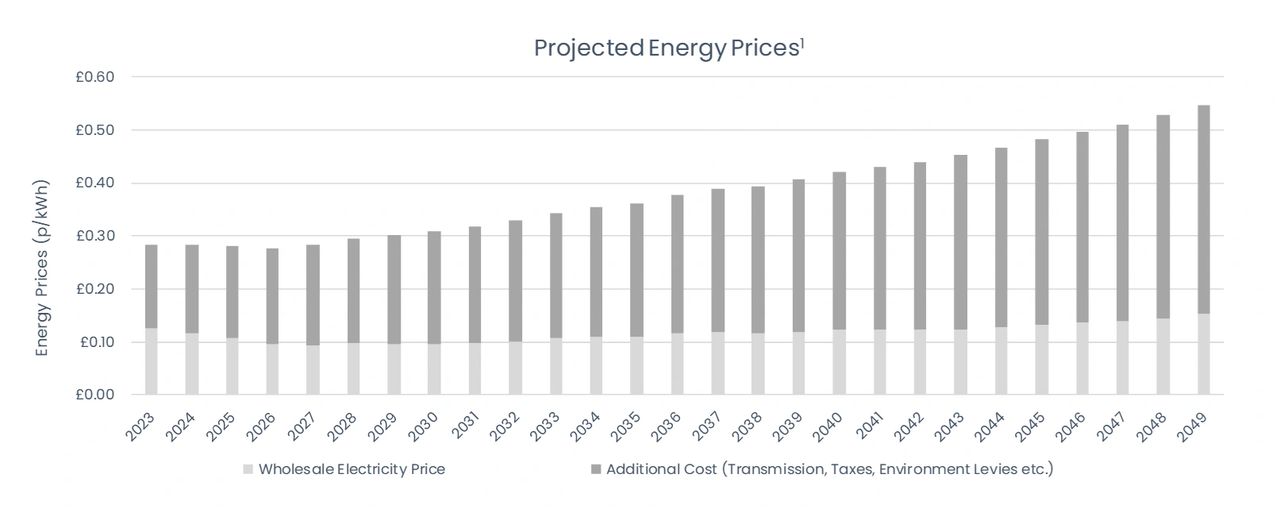
Most quotes will show you the expected savings associated with the PPA. These projected savings may differ greatly from one quote to another. It’s therefore important to understand how they’ve been calculated and not to make your decision based on these savings figures alone.
In particular, no one has a crystal ball and forecasting savings over the next 20-25 years will involve a high degree of speculation.
At Two Blues Solar, we use Aurora energy market forecasts alongside other predictions of future market fluctuations. If you provide us with your existing energy price, we will then scale this against future projections to give you the most realistic possible forecast.
Step 5: How Flexible Is The PPA Provider? 🌤️
Like solar installers, PPA providers come in all shapes and sizes. Some will be more flexible in their approach than others. Examples of flexibility include:
- The ability to accommodate a short lease
- The option to incorporate additional costs into the PPA – eg: roof repair, electrical upgrades, batteries, EV chargers or the purchase of existing solar
- Will they manage and cover the pre-installation costs – eg: structural surveys, DNO & planning consent. Some PPA providers will only step in once this process is complete.
- Flexibility on the term and pricing methodology they will offer you
- The buy-out terms: it’s worth understanding what happens if you want to break the agreement at any stage
Step 6: Who Are You Dealing With? 🤝
You may find that there are many people who approach you and offer a PPA. As an example, quotes may come from installers, energy brokers, project developers and PPA finance providers.
The important thing to understand is exactly who all the parties involved are and their respective roles.
The most important parties are the company who is going to install the system and the company providing the funding. Make sure you get a good understanding of where the funding comes from and the level of experience of the installation partner.
And finally, it may sound obvious, but make sure you like and trust them! A PPA is a long-term agreement and you want to work with someone who will be transparent and clear with you.
As you can see, there’s a number of things to consider when comparing PPA quotes. We’ve therefore put together this handy “cheat sheet” to help you ask the right questions.
Cheat Sheet: Top Questions To Ask:
- Am I comparing like-for-like in terms of: system size, PPA term, pricing methodology
- What are the installation costs that the PPA provider expects to incur? How much contingency has been built in?
- When does the PPA price get locked in?
- What are the buy-out terms?
- What level of self-consumption is the PPA provider assuming, and is there a minimum consumption requirement?
- Is it based on “take-or-pay” (ie: you purchase everything generated) or “pay-as-consumed” where you only purchase what you use?
- What is the quality of the panels and equipment to be used?
- How will the system be monitored and maintained and how this will be reported to you?
- Who are all the different parties involved?
If you’d like to get a PPA quote from us or find out more about how PPAs work, please get in touch at: info@twobluessolar.com